
Feather banners are widely used for outdoor advertising, trade shows, retail promotions, exhibitions, sporting events, and commercial displays. Their tall, curved shape provides a large visible advertising area while allowing the banner to move naturally with airflow. For manufacturers of promotional flags and textile display products, selecting the right feather banner fabric directly affects print quality, durability, appearance, and production efficiency.
Feather banner fabric for dye sublimation printing is generally made from lightweight polyester material, particularly knitted polyester. This type of fabric supports full-color printing, flexible banner construction, and detailed graphic reproduction. It can also be manufactured in different weights, widths, and finishes to meet the requirements of various advertising applications.
Compared with conventional vinyl banners, polyester fabric banners offer a softer textile appearance, convenient handling, and compatibility with dye sublimation printing. Depending on the fabric construction and finishing treatments, they can also provide suitable tear resistance, wrinkle resistance, and weather resistance for indoor and outdoor displays.
This guide explains the properties of feather banner fabric, the dye sublimation printing process, material selection, finishing options, and the differences between polyester and other banner materials.
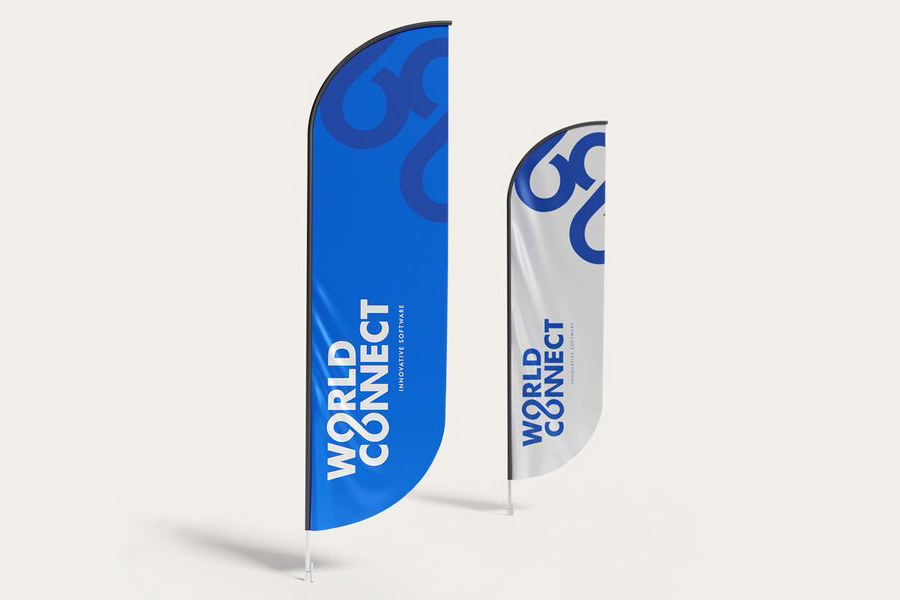
Feather banner fabric is a lightweight, flexible textile material used to manufacture feather-shaped advertising banners and promotional displays. It is commonly produced from knitted polyester, which provides a suitable structure for dye sublimation printing, full-color graphics, and flexible banner designs. The finished fabric can be cut, sewn, and fitted with pole pockets or other mounting features for installation on compatible pole sets.
Unlike rigid advertising panels, feather banners are designed to move with changing airflow. Their curved shape and flexible construction make them suitable for roadside advertising, retail promotions, sporting events, trade shows, and other promotional environments.
Common characteristics of feather banner fabric include:
The appropriate fabric specification depends on the banner dimensions, installation environment, printing equipment, and expected service conditions.
Knitted polyester is widely used in textile advertising products because it combines flexibility, lightweight construction, and compatibility with dye sublimation printing.
Compared with rigid banner substrates, knitted polyester provides a softer surface that can move naturally in outdoor airflow. Its textile structure also makes it suitable for sewing and producing custom banner shapes.
Feather banners are designed to move with the wind rather than remain completely rigid. Lightweight knitted polyester allows the banner to follow the movement of air while maintaining its intended shape.
This construction also makes finished banners easier to fold, package, transport, and install.
Polyester material is suitable for dye sublimation printing because heat-activated disperse dyes can penetrate and bond with polyester fibers.
The process produces graphics within the textile structure rather than leaving a thick ink layer on the surface. This helps preserve the fabric's flexibility and soft appearance.
Feather banner fabric can reproduce a wide range of graphic elements, including:
With appropriate fabric specifications and printing conditions, manufacturers can achieve vibrant colors and a high quality print suitable for commercial advertising.
The mechanical performance of knitted polyester depends on yarn quality, fabric weight, knitting construction, and finishing processes.
A properly selected polyester fabric can provide suitable tear resistance for routine advertising use. Its flexible structure also helps reduce the appearance of wrinkles during normal handling.
However, these properties vary between fabric grades. Manufacturers should evaluate physical test results rather than assuming that all polyester banners offer the same performance.
When purchasing banner materials for commercial production, buyers should evaluate more than the fabric's appearance. Material specifications affect printing results, sewing performance, transportation, and long-term use.
Fabric weight is generally measured in grams per square meter (GSM). It affects the banner's handling characteristics, flexibility, strength, and overall appearance.
Lightweight fabric is often preferred for feather banners because it allows the material to move freely. However, extremely lightweight material may not provide sufficient strength for larger banners or demanding applications.
When comparing fabric specifications, consider:
The most suitable GSM depends on the banner size, construction, and application rather than a single universal specification.
A consistent fabric surface supports stable printing results and reduces the likelihood of visible defects.
For high-quality print production, the material should have uniform knitting, consistent density, and minimal surface irregularities.
Fabric uniformity is particularly relevant when printing large advertising graphics with solid color backgrounds, detailed photographs, and fine text.
The ability to reproduce vibrant colors depends on the polyester composition, fabric pretreatment, sublimation ink, transfer paper, and heat-transfer conditions.
Manufacturers should conduct sample printing tests to evaluate:
For commercial advertising, color consistency helps maintain a recognizable brand appearance across multiple banners.
Feather banners often require precise cutting and sewing to fit specific pole sets.
Fabric shrinkage or distortion during heat transfer can affect the finished banner dimensions and the position of the printed graphics.
Suitable polyester material should maintain stable dimensions under the recommended printing conditions. Manufacturers should verify dimensional changes before beginning large production runs.
Outdoor banners may experience sunlight, wind, rain, humidity, and changing weather conditions.
The fabric should have sufficient mechanical strength for its intended application. Printing dyes should also provide suitable lightfastness to help maintain graphic appearance during outdoor exposure.
Additional UV-resistant or water-repellent treatments may be considered when required by the installation environment.
Dye sublimation printing is a heat-transfer process used to produce detailed, full-color graphics on polyester textiles.
During the process, specialized disperse dyes are transferred from printed paper into the polyester fibers under controlled heat and pressure.
Unlike conventional surface printing, the dye becomes integrated into the fiber structure, helping preserve the flexibility and texture of the fabric.
The customer's graphic design is prepared according to the required feather banner dimensions and printing specifications.
The artwork should include the correct proportions, print area, and any necessary allowances for cutting and sewing.
Brand colors, logos, and text should be checked before printing.
A digital sublimation printer applies specialized sublimation ink to transfer paper.
The printed transfer paper contains the design that will be transferred onto the polyester fabric.
Printer settings and color profiles should be configured according to the ink, paper, and fabric specifications.
The polyester fabric is positioned against the printed transfer paper.
Accurate alignment helps prevent image distortion, unwanted movement, and printing defects.
For large-format feather banners, consistent fabric feeding is necessary to maintain graphic alignment throughout production.
The fabric and transfer paper pass through a heat press or calendar heat-transfer machine.
Under controlled conditions, the dyes transfer into the polyester fibers and develop the intended colors.
The appropriate temperature, pressure, and processing time depend on the fabric construction, ink system, transfer paper, and equipment.
After printing, the fabric should be checked for:
These checks help identify production issues before the material is cut and sewn.
The printed fabric is cut according to the feather banner pattern.
Depending on the product design, finishing may include pole pockets, reinforced edges, stitched seams, and other mounting structures.
The completed banner is then inspected to ensure that its dimensions, sewing, and printed graphics meet the required specifications.
Feather banners can be manufactured with single-sided or double-sided printing, depending on the required visibility and advertising environment.
Single-sided printing applies the graphic to one side of the polyester fabric.
The printed image may be visible in reverse from the backside, depending on the material construction.
Advantages include:
Single-sided feather banners are commonly used for roadside promotions, storefront advertising, retail campaigns, and sporting events.
Double sided printing is designed for applications where graphics need to be visible from both directions.
A typical double-sided feather banner uses two printed fabric panels with an opaque or light-blocking layer between them. This construction helps reduce image show-through and allows each side to display a separate graphic or the same design in the correct orientation.
Advantages include:
The additional fabric and internal layer can increase the finished banner's weight. Manufacturers should consider the pole set specifications and wind exposure when selecting this construction.
Printing quality is only one part of a finished advertising banner. The fabric must also be properly cut and finished to fit the intended support structure.
Pole pockets are sewn fabric channels that allow supporting poles to pass through the banner.
They are commonly used in feather banners, advertising flags, and other fabric display systems.
The pocket dimensions should match the diameter and configuration of the intended pole sets. Incorrect sizing may make installation difficult or cause excessive tension on the fabric.
Pole Pockets: Sewn channels designed to accommodate the supporting poles.
Reinforced Edges: Additional stitching or reinforcement helps reduce damage around areas exposed to repeated movement and handling.
Bottom Reinforcement: Strengthens areas that experience tension during installation.
Custom Cutting: Allows the fabric to follow feather, blade, teardrop, and other banner profiles.
Custom Sewing: Supports different dimensions, pocket widths, and installation requirements.
When ordering custom fabric banners, buyers should provide the required finished dimensions, pole specifications, and sewing details before production begins.
Polyester fabric banners and vinyl banners are both widely used in advertising. However, they have different material structures, printing methods, handling characteristics, and applications.
| Comparison | Polyester Feather Banner Fabric | Vinyl Banners |
|---|---|---|
| Material | Knitted or woven polyester | PVC-based flexible material |
| Surface | Soft textile surface | Smooth or coated surface |
| Printing | Dye sublimation and other compatible textile printing methods | Commonly solvent, eco-solvent, UV, or latex printing |
| Appearance | Fabric-based advertising appearance | More rigid banner appearance |
| Flexibility | Generally flexible and lightweight | Depends on thickness and formulation |
| Weight | Often lightweight | Varies by vinyl thickness |
| Wrinkle resistance | Generally good, depending on construction | Can develop creases during folding |
| Sewing | Suitable for sewn finishing and pole pockets | Usually uses welding, hems, or other finishing methods |
| Outdoor applications | Feather flags and promotional displays | Outdoor signs, large-format banners, and temporary advertising |
Polyester is a suitable choice when the advertising product requires:
Vinyl banners may be more suitable for applications requiring a coated surface, different mounting methods, or particular waterproof and heavy-duty specifications.
The choice depends on the intended display structure, printing equipment, installation conditions, and customer requirements.
Neither material is universally better. Each should be evaluated according to the actual application.
Feather banners are used across different commercial environments because they combine a large advertising area with portable construction.
Feather banners help exhibitors display company logos, product information, promotional messages, and directional signage.
Their lightweight construction makes them convenient for transportation between exhibition venues.
Retail businesses use feather banners to promote seasonal discounts, product launches, new store openings, and special offers.
They can be installed near entrances, storefronts, and promotional areas.
Feather banners are frequently used at sporting competitions, festivals, community events, and outdoor exhibitions.
Their curved profile and movement help attract attention in open spaces.
Businesses use feather banners to identify entrances, promote services, and communicate temporary advertising messages.
Suitable polyester fabric allows the banner to move with airflow while displaying printed graphics.
Feather banners can also be used for indoor display applications, including exhibition booths, shopping malls, showrooms, and conference venues.
For indoor environments, buyers may prioritize color reproduction, fabric appearance, lightweight handling, and compatibility with portable pole sets.
For printing companies, advertising manufacturers, and wholesale distributors, choosing a suitable supplier helps maintain material consistency and production efficiency.
Request detailed technical information covering polyester composition, GSM, width, construction, thickness, and finishing options.
The supplier should provide clear specifications for each fabric grade.
Sample testing helps determine whether the fabric is compatible with the intended dye sublimation printing equipment.
Evaluate color development, graphic clarity, fabric shrinkage, and surface consistency.
Depending on the application, request relevant test data for tensile strength, tear resistance, dimensional stability, and colorfastness.
These properties provide useful information about how the material may perform during handling and use.
For custom fabric banners, confirm whether the supplier can provide:
For repeat orders, consistent fabric specifications help reduce printing and sewing variations.
Manufacturers should establish quality inspection procedures for incoming materials and finished banners.
Knitted polyester is one of the most commonly used materials for feather banners. It provides lightweight construction, flexibility, suitable tear resistance, and compatibility with dye sublimation printing. The appropriate GSM and fabric construction depend on the banner dimensions and intended application.
Polyester fibers can bond with heat-activated disperse dyes during the sublimation process. This allows manufacturers to produce full-color graphics with detailed images and vibrant colors while maintaining the fabric's flexible textile structure.
Knitted polyester is produced by interlooping yarns, creating a flexible textile structure suitable for applications such as feather banners. Woven polyester is made by interlacing yarns and generally provides a more structured surface. The appropriate choice depends on the required flexibility, strength, appearance, and printing performance.
Yes. Double-sided printing is available for feather banners. A typical construction uses two printed polyester panels with an opaque or light-blocking layer between them to reduce image show-through. Each side can display the same or different graphics.
Pole pockets are sewn channels that allow supporting poles to pass through the fabric. They help hold the banner in its intended shape and connect the printed material to the supporting pole sets. Pocket dimensions should match the pole specifications.
Polyester feather banner fabric can provide suitable tear resistance when manufactured with appropriate yarn quality, fabric density, and construction. Actual performance varies according to GSM, knitting structure, finishing, and sewing quality.
Polyester generally offers good wrinkle recovery compared with many natural textile materials. However, folding pressure, storage conditions, fabric weight, and finishing can affect the appearance of the finished banner. Proper folding and storage help reduce wrinkles.
Suitable polyester feather banner fabric can be used outdoors under normal weather conditions. However, its actual performance depends on UV resistance, fabric strength, dye lightfastness, water-repellent treatments, and installation conditions. Severe wind and prolonged exposure may shorten the product's service life.
The service life depends on fabric quality, printing dyes, sunlight exposure, wind conditions, installation methods, and maintenance. Banners used continuously outdoors under strong sunlight and wind may require more frequent replacement than those used occasionally.
Yes. Feather banner fabric is suitable for indoor display applications such as trade shows, exhibitions, retail promotions, showrooms, and conferences. Its lightweight construction and full-color printing make it suitable for portable advertising displays.
Fabric banners are generally made from polyester and provide a soft textile appearance with flexible handling and dye sublimation compatibility. Vinyl banners are made from PVC-based materials and are commonly used for large-format signage and other coated-banner applications. The best option depends on the intended display and printing requirements.
Yes. Custom fabric banners can be produced with different dimensions, shapes, and pole pocket specifications. Buyers should provide the required banner measurements and pole set details to ensure a suitable fit.
Feather banner fabric for dye sublimation printing is commonly made from knitted polyester, offering a practical combination of flexibility, lightweight construction, full-color printing compatibility, and convenient finishing.
When selecting banner materials, manufacturers should evaluate fabric weight, surface consistency, tear resistance, wrinkle resistance, dimensional stability, and performance under the expected weather conditions. They should also consider whether single-sided or double-sided printing, pole pockets, and custom finishing are required.
By matching the polyester fabric specifications with the intended printing process and display environment, advertising manufacturers and textile printing businesses can produce high-quality feather banners for trade shows, indoor display systems, retail promotions, and outdoor advertising.