

Feather flags are widely used for outdoor advertising, trade shows, retail promotions, sporting events, exhibitions, and roadside signage. Their distinctive curved shape, lightweight construction, and large printable surface make them an effective way to display brand messages and promotional graphics.
The quality of a feather flag depends largely on the fabric used for printing. The right feather flag fabric should provide consistent dye sublimation results, clear color reproduction, sufficient flexibility, and reliable weather resistance. It should also maintain its appearance during outdoor use, transportation, storage, and routine cleaning.
For manufacturers of advertising flags and textile printing businesses, selecting suitable dye sublimation flag material involves evaluating fabric composition, weight, surface structure, ink absorption, dimensional stability, and finishing performance.
This guide explains how feather flag fabric works with dye sublimation printing, what material properties to consider, and how to maintain printed flags for long-term use.
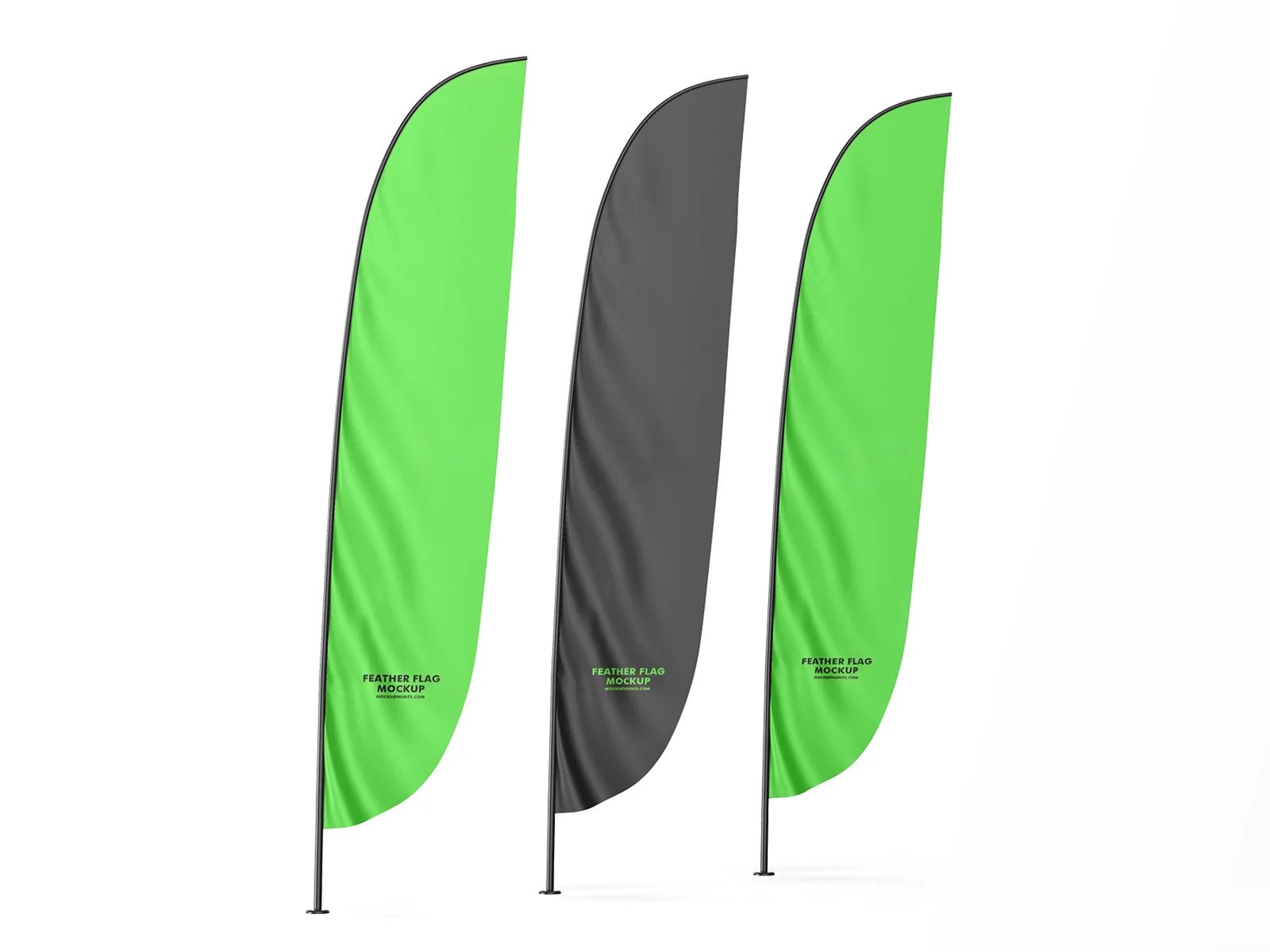
Feather flag fabric is a lightweight, flexible textile material designed for manufacturing feather-shaped advertising flags and promotional banners. It is commonly made from polyester because polyester fibers are compatible with dye sublimation printing, allowing heat-transferred dyes to bond with the fibers and produce colorful, detailed graphics.
Feather flag material is typically selected for its balance of print quality, flexibility, strength, and outdoor performance. It needs to move naturally with changing wind conditions while maintaining sufficient dimensional stability to keep the printed design recognizable.
Unlike rigid advertising panels, feather flags are designed to flex and move outdoors. Therefore, the fabric must combine a lightweight structure with suitable tensile strength and resistance to fraying.
Common characteristics of feather flag fabric include:
Polyester is one of the most widely used materials for dye sublimation advertising flags. Its fiber structure supports the heat-transfer printing process, while its lightweight properties make it suitable for large-format textile displays.
Compared with cotton and other natural fibers, polyester offers several advantages for promotional flag production.
Dye sublimation printing uses heat to transfer specialized dyes into polyester fibers. The resulting image is integrated into the textile rather than remaining as a separate ink layer on the surface.
This process provides vibrant colors and detailed graphics without creating a thick printed coating that could affect the fabric's flexibility.
Feather flags need to move with the wind. Heavy or excessively rigid materials can affect their movement and increase mechanical stress on the flag structure.
Lightweight polyester fabric offers a practical combination of flexibility and strength, making it suitable for curved advertising flags and other outdoor display products.
A suitable polyester flag material maintains its shape during printing, sewing, and normal handling. Dimensional stability helps prevent excessive shrinkage, distortion, or changes in the flag's proportions.
This is particularly relevant when manufacturers produce flags in different sizes and require consistent finished dimensions.
Many polyester feather flag fabrics can be cleaned using cold water and mild detergent, provided that the fabric construction and printing specifications allow it.
Their relatively low moisture absorption also supports faster drying compared with many natural textile materials.
Choosing the right fabric involves more than comparing material prices. Several physical and printing characteristics affect the finished product's appearance and service performance.
Fabric weight influences the movement, handling, and durability of feather flags.
Lightweight materials are generally suitable for advertising flags that need to move freely in outdoor conditions. However, extremely lightweight fabric may have insufficient strength for certain applications or may be more susceptible to damage during repeated use.
Manufacturers should evaluate:
The appropriate GSM depends on the flag design, intended environment, printing equipment, and customer requirements. A higher fabric weight does not automatically mean better flag performance.
A consistent fabric surface helps achieve uniform printing results.
Uneven yarn structures, excessive surface texture, and inconsistent fabric density can affect fine graphic details and color distribution.
For high-quality feather flags, manufacturers should look for:
The fabric must support effective dye transfer and color development during the printing process.
Factors affecting the final image include polyester content, fabric pretreatment, ink formulation, transfer temperature, pressure, and processing time.
A properly selected flag material can reproduce:
Color consistency should be checked through production testing rather than relying only on the appearance of an unprinted fabric sample.
Feather flags are exposed to repeated movement and changing wind conditions. The fabric needs sufficient mechanical strength to resist tearing around stitched edges, pole sleeves, and attachment points.
Manufacturers should consider both the base fabric's mechanical properties and the quality of sewing and finishing.
Reinforced stitching and suitable edge finishing can help reduce premature damage during outdoor use.
Dye sublimation is a heat-transfer printing method commonly used to produce colorful polyester advertising flags.
During this process, specially formulated sublimation ink is transferred from printed paper into polyester fibers under controlled heat and pressure.
Step 1: Prepare the Digital Artwork
The customer's design is prepared using graphic design software. The artwork should match the required flag dimensions, print area, and cutting specifications.
Color profiles and printer settings should be configured according to the ink, fabric, and printing equipment.
Step 2: Print the Design onto Transfer Paper
A sublimation printer applies specialized dye sublimation ink to transfer paper.
The printed paper contains the graphic that will later be transferred onto the polyester flag material.
Step 3: Position the Fabric and Transfer Paper
The printed transfer paper is placed against the polyester fabric.
Correct positioning helps prevent unwanted movement, image distortion, and alignment problems during heat transfer.
Step 4: Apply Heat and Pressure
The fabric and transfer paper pass through a heat press or calendar heat-transfer machine.
Under controlled conditions, the sublimation dyes transfer into the polyester fibers and develop the intended colors.
Temperature, pressure, and processing time should be adjusted according to the material and ink manufacturer's specifications.
Step 5: Inspect the Printed Fabric
After transfer, the fabric is inspected for color accuracy, image clarity, registration, and visible defects.
Manufacturers should also check dimensional stability and fabric consistency before proceeding to cutting and sewing.
Step 6: Cut and Sew the Feather Flag
The printed fabric is cut according to the feather flag pattern. The edges are then finished, and the pole sleeve or other attachment structures are sewn into place.
Final inspection should cover the overall dimensions, stitching quality, graphic alignment, and finished appearance.
Feather flags can be manufactured in single-sided or double-sided configurations, depending on the required visibility and advertising environment.
| Feature | Single-Sided Feather Flags | Double-Sided Feather Flags |
|---|---|---|
| Printing structure | One printed fabric layer | Two printed layers |
| Backside visibility | Often shows a reversed image | Displays a separate or corresponding image |
| Material usage | Generally lower | Generally higher |
| Weight | Usually lighter | Usually heavier |
| Wind movement | Typically more flexible | Depends on the combined fabric construction |
| Applications | Roadside advertising, outdoor promotions | Locations requiring visibility from both directions |
For single-sided feather flags, the design is printed on one side of the fabric, and the image may be visible in reverse from the back.
Double-sided flags commonly use two printed fabric panels with an opaque or light-blocking layer between them. This helps prevent the graphics on one side from showing through the other.
The appropriate structure depends on visibility requirements, installation location, weight preferences, and production budget.
Weather resistance is an important consideration when selecting feather flag material for outdoor advertising.
Outdoor flags may experience sunlight, rain, humidity, wind, and temperature changes. Suitable polyester fabric provides a practical foundation for these applications, but its actual performance depends on fabric construction, dye quality, finishing treatments, and manufacturing standards.
Feather flags are designed to move naturally with airflow. Flexible polyester fabric allows the flag to respond to wind rather than behaving like a rigid panel.
However, no fabric is completely resistant to damage from strong winds. Severe weather, excessive wind pressure, and incorrect installation can cause tearing or damage to the flag and its supporting structure.
Prolonged UV exposure can gradually affect textile colors and fiber properties.
For outdoor applications, manufacturers should evaluate the lightfastness of the printed fabric and consider suitable UV-resistant treatments when longer outdoor exposure is required.
Actual color retention depends on the sublimation dyes, printing conditions, fabric specifications, and exposure intensity.
Polyester generally absorbs less moisture than natural fibers and dries relatively quickly.
This makes it suitable for outdoor promotional flags that may encounter occasional rain or humid conditions.
Nevertheless, standard polyester feather flag fabric should not automatically be considered waterproof. Water resistance depends on additional coatings or treatments.
Outdoor flags may be exposed to hot summer conditions and cooler temperatures.
A suitable polyester fabric can maintain flexibility across normal outdoor operating conditions. However, extreme temperatures and prolonged environmental exposure may affect the fabric, printed colors, and sewing components.
For demanding applications, manufacturers should evaluate the finished product under conditions representative of its intended use.
Proper cleaning and storage help maintain the appearance of printed feather flags and extend their usable life.
Although polyester is relatively easy to maintain, the washing method should match the fabric construction, printing specifications, and finishing treatments.
Many polyester feather flags can be machine washed using a gentle cycle. However, machine washing should only be used when permitted by the fabric and finished-product manufacturer's care instructions.
For routine cleaning, follow these recommendations:
If the flag includes special coatings, reinforced components, or delicate finishing, hand washing may be a more suitable option.
Yes. Air dry is generally a suitable drying method for polyester feather flags.
After washing, gently remove excess water without aggressively twisting the fabric. Hang the flag in a well-ventilated area and allow it to dry naturally.
Avoid excessive heat from dryers or direct high-temperature sources, particularly when the material has special finishing treatments.
Before reinstalling the flag, make sure it is completely dry.
Proper storage helps prevent unnecessary fabric damage and discoloration.
For better storage conditions:
These practices help maintain the printed design and fabric condition between advertising campaigns.
Different advertising products require different fabric characteristics. Feather flag material is designed primarily for flexible, lightweight vertical displays, while other banner fabrics may prioritize surface smoothness, opacity, or structural stability.
| Fabric Type | Typical Characteristics | Common Applications |
|---|---|---|
| Feather flag polyester | Lightweight, flexible, sublimation compatible | Feather flags, blade flags |
| Knitted polyester | Flexible textile construction | Advertising flags, textile displays |
| Woven polyester | More structured fabric construction | Outdoor banners, promotional flags |
| Blockout fabric | Designed to reduce light transmission | Double-sided banners, display graphics |
| SEG fabric | Designed for silicone-edge graphic systems | Exhibition displays, fabric lightboxes |
The best material depends on the finished product's structure and intended application.
For example, SEG fabric is generally developed for silicone-edge graphic systems, where the fabric is inserted into an aluminum frame. It is not necessarily interchangeable with conventional feather flag fabric.
For flag manufacturers, printing companies, and advertising material distributors, supplier selection affects both production efficiency and finished-product consistency.
Before placing a bulk order, consider the following factors.
Confirm the polyester composition, GSM, thickness, width, and textile construction.
The supplier should provide clear product specifications so that the material can be matched with the intended printing equipment.
Ask whether the material has been tested with the intended sublimation ink and transfer equipment.
A sample printing test can help evaluate color development, image clarity, and fabric stability.
Consistent fabric weight, width, surface construction, and printing performance are necessary for repeat orders.
Manufacturers should establish incoming material inspection procedures to identify differences between production batches.
Depending on the application, request relevant test information covering:
These results provide a more reliable basis for material selection than appearance alone.
For large-volume flag production, evaluate the supplier's ability to provide customized widths, fabric weights, finishing options, and stable delivery schedules.
A supplier with consistent manufacturing and quality-control procedures can help reduce material variation and production interruptions.
Feather flag fabric is mainly used for promotional and directional advertising where lightweight construction and visible graphics are required.
Typical applications include:
Retail and Shopping Centers: Display promotional messages, seasonal discounts, new product launches, and store branding.
Trade Shows and Exhibitions: Provide portable advertising displays and help exhibitors improve booth visibility.
Sports Events: Display team branding, event information, sponsor logos, and directional messages.
Roadside Advertising: Attract attention to businesses, sales campaigns, property developments, and temporary promotions.
Outdoor Events and Festivals: Support event identification, entrance signage, sponsor displays, and promotional activities.
Automotive Dealerships: Promote vehicle launches, special offers, and dealership branding.
The flexibility and printing compatibility of polyester make it suitable for customized advertising graphics across different industries.
Polyester is one of the most suitable materials for dye sublimation feather flags because sublimation dyes bond effectively with polyester fibers. The ideal fabric should also provide appropriate GSM, flexibility, tensile strength, dimensional stability, and printing consistency.
Polyester supports dye sublimation printing, offers lightweight construction, dries relatively quickly, and provides suitable flexibility for outdoor advertising flags. It also allows manufacturers to produce colorful graphics with detailed designs.
Many polyester feather flags can be machine washed using a gentle cycle, provided that the manufacturer's care instructions permit it. Cold water and mild detergent are generally recommended. Avoid bleach, aggressive washing, and excessive heat.
Yes. Air drying is generally recommended for polyester feather flags. Hang the washed material in a well-ventilated area and allow it to dry completely before storage or reuse.
Standard polyester feather flag fabric is not necessarily waterproof. Polyester has relatively low moisture absorption, but waterproof performance requires suitable coatings or additional treatments. Always check the specific fabric specifications before using it in applications requiring waterproof protection.
The service life of an outdoor feather flag depends on fabric quality, printing dyes, UV exposure, wind conditions, installation methods, and maintenance. Flags exposed to strong winds and continuous sunlight may wear out faster than those used in moderate conditions.
Yes. Double-sided feather flags can be manufactured using two printed fabric panels, often with an opaque layer between them. This construction helps reduce image show-through and allows separate graphics to be displayed on each side.
The suitable GSM depends on the flag size, desired movement, printing equipment, and intended application. Lightweight polyester is commonly used for feather flags, but manufacturers should evaluate fabric strength, print performance, and finished-product durability rather than choosing GSM alone.
Dye sublimation produces graphics integrated into polyester fibers, which helps avoid the surface cracking and peeling associated with some surface-printing methods. However, overall weather resistance also depends on dye lightfastness, fabric quality, finishing, sewing, and environmental exposure.
Yes. Similar polyester fabrics may be used for blade banners, teardrop flags, sail flags, rectangle flags, and other textile advertising displays. However, the material specifications should be matched to the structure and performance requirements of each product.
Selecting the right feather flag fabric for dye sublimation printing requires evaluating polyester composition, fabric weight, surface consistency, color reproduction, mechanical strength, and outdoor performance.
A suitable flag material supports vibrant graphics, flexible movement, efficient manufacturing, and convenient maintenance. Proper washing with cold water, air drying, and appropriate storage can also help preserve the appearance of printed flags.
For manufacturers and advertising textile suppliers, evaluating fabric specifications and conducting printing and durability tests before bulk production helps achieve consistent finished-product quality across different feather flag applications.