

Sublimation printing is widely used for sportswear, flags, soft signage, home textiles, promotional products, and other polyester-based applications. Unlike traditional printing methods, the ink does not simply sit on top of the fabric. Under the right heat and pressure, sublimation ink changes into a gas and enters the polyester fibers.
This process creates a strong connection between the dye and the fabric. The printed design becomes part of the textile surface rather than forming a thick layer on top.
Understanding how sublimation ink bonding works can help printers, fabric buyers, and textile manufacturers choose the right polyester fabric, transfer paper, sublimation printers, and heat press settings.
Sublimation ink bonds with polyester fabric when heat and pressure turn solid dye particles into a gas. The gas moves from the sublimation paper into the heated polyester fibers, where it cools and becomes trapped inside the polymer structure. This creates a permanent textile printing effect that produces vibrant color without leaving a thick ink layer on the surface.
Dye sublimation works best with white or light-colored polyester fabric because the process does not normally use white ink. Higher polyester content generally gives better color transfer and more consistent results.
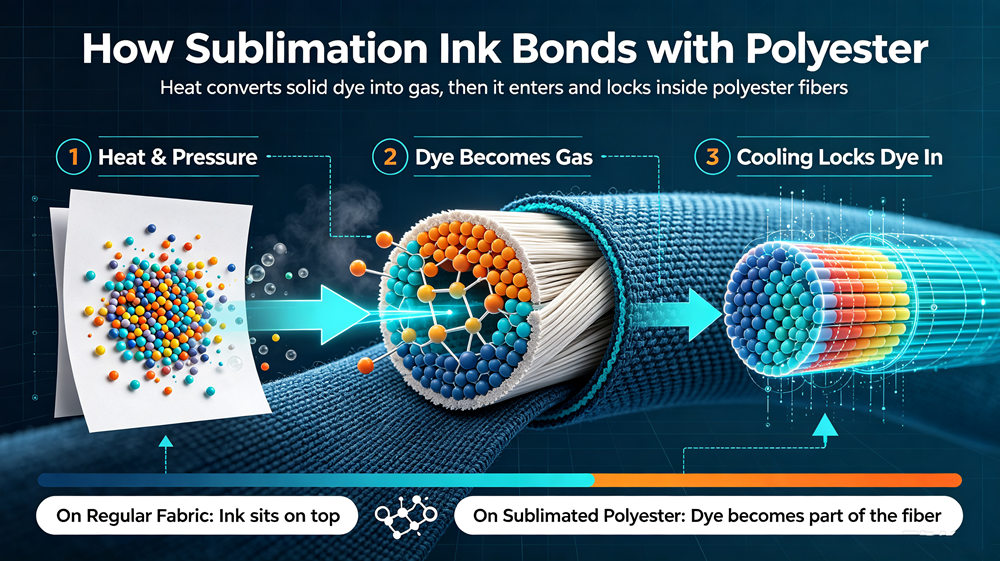
Sublimation ink bonding is the process in which dye from sublimation ink enters polyester fibers during a high-temperature transfer process and becomes part of the polymer structure.
Unlike regular ink, sublimation dye is designed to move from a solid state into a gas when exposed to sufficient heat. The gas can then enter the polyester material.
When the material cools, the dye returns to a solid state inside the polyester fibers.
This is why a properly sublimated print does not feel like a separate layer of ink on the fabric.
Dye sublimation is a digital printing process that uses heat to transfer dye into polyester or a polyester-coated surface.
The basic process is:
Epson describes the process as printing the design onto transfer paper and then applying heat so the ink becomes a gas and is absorbed into polyester or other suitable materials.
The answer is found in the structure of polyester.
Polyester is a synthetic polymer. Its molecular structure responds well to the heat used in the sublimation process.
When polyester is heated, its polymer structure becomes more receptive to the gaseous dye. At the same time, the sublimation dye becomes mobile enough to move from the transfer paper into the fabric.
Once the fabric cools, the polymer structure closes again and the dye remains within the fiber.
This creates a different result from conventional surface printing.
With many regular printing methods, the ink sits on top of the textile.
With dye sublimation, the dye moves into the polyester fibers.
The sublimation process has several connected stages.
The first step is to prepare the digital artwork.
Color management is important because the design shown on a computer screen may not match the final printed result.
The printer, sublimation ink, paper, fabric, and heat press all affect the final color.
For commercial production, it is useful to create test prints before starting a large production run.
The artwork is printed onto special sublimation paper using sublimation ink.
Sublimation printers are usually inkjet printers designed or configured for sublimation inks.
The print may look less vibrant on the paper than it does after pressing. This is normal because the final color develops when the dye is heated and transferred into the polyester fabric. Epson also notes that a sublimation transfer can look less vibrant before pressing.
The print head must also be kept clean and properly maintained.
Blocked nozzles or uneven ink delivery can create lines, missing colors, and inconsistent image density.
Sublimation paper is more than ordinary paper.
It has a special coating that holds the sublimation ink until the transfer stage.
The coating needs to release the dye efficiently when exposed to heat.
Regular copier paper is not a suitable replacement for properly designed sublimation paper. Sawgrass notes that sublimation paper is designed to hold the ink and release it during the heat transfer process.
The paper also needs to remain stable during heating. Paper movement can cause blurred edges or ghosting.
The printed transfer paper is placed against the polyester fabric.
The printed side normally faces the fabric.
Good contact between the paper and fabric helps the gaseous dye move evenly into the material.
If the paper moves during pressing, the image can become blurred or produce a double image.
For this reason, commercial printers often use heat-resistant tape or other methods to keep the transfer in place.
Heat and pressure start the transfer process.
The heat causes the sublimation dye to change into a gas.
Pressure helps maintain close contact between the transfer paper and polyester fabric.
Both temperature and time affect the result.
If the temperature is too low, the dye may not transfer completely.
If the temperature is too high or the fabric is exposed for too long, color changes, fabric distortion, or other problems can occur.
A commonly used reference point for polyester fabric is around 400°F (204°C), but this should not be treated as a universal setting. Sawgrass provides 400°F/204°C as a reference for polyester fabric in one of its heat press guides, while also recommending testing and following substrate-specific instructions.
As the temperature rises, the sublimation dye becomes gaseous.
The gas moves from the transfer paper toward the heated polyester fabric.
The dye then enters the polymer structure of the polyester fibers.
This is the stage where sublimation ink bonding takes place.
The process is sometimes described as the dye becoming part of the material instead of forming a coating on its surface.
After pressing, the fabric is allowed to cool.
The transfer paper is then removed.
As the polyester cools, the dye becomes stable inside the fibers.
The final print should have a smooth surface with no thick ink layer.
Polyester is particularly suitable because sublimation dyes are designed to interact with synthetic polymer fibers.
The higher the polyester content, the more surface area is available for the dye to bond with during the transfer.
This is one reason 100% polyester fabrics are widely used for high-quality sublimation applications.
Common examples include:
Epson recommends polyester or polyester-coated materials for dye sublimation and notes that higher polyester content can produce more vibrant results.
100% polyester is generally the easiest material to use for dye sublimation.
A polyester blend can also be printable, but the result depends on the percentage and type of other fibers.
For example, if a fabric contains a large amount of cotton, the cotton fibers do not accept sublimation dye in the same way as polyester.
The polyester portion can receive the dye, while the non-polyester fibers remain largely unaffected.
This can make the print appear lighter or less saturated.
For applications where strong color and consistent coverage are required, 100% polyester fabric is usually the safer choice.
Sublimation printing is different from printing systems that use white ink.
The dye becomes part of the fabric, but it does not normally cover the existing fabric color.
For example, a yellow sublimation design printed on white polyester can appear bright and clear.
The same design printed on black fabric cannot produce the same result because the dark background changes the appearance of the dye.
This is why white and light colored polyester fabrics are commonly used.
Epson specifically recommends white or light-colored polyester fabrics for best dye-sublimation results and advises against dark fabrics for standard dye sublimation.
Standard dye sublimation is generally not suitable for dark fabric.
The main reason is that sublimation systems normally do not print white ink.
A dark textile can therefore overpower the transferred colors.
For dark garments, other technologies such as direct-to-film or specialized textile printing systems may be more appropriate.
The choice depends on the fabric, application, required appearance, and production method.
Sublimation is not limited to textiles.
The process can also work on hard products that have a suitable polymer coating.
The polymer coating provides a surface that can accept sublimation dye.
Examples include certain:
The same basic principle applies: heat turns the dye into a gas, and the dye enters a suitable polymer surface.
Sawgrass notes that sublimation requires polyester materials or products with a suitable polymer coating.
The main difference is how the printed dye interacts with the material.
A regular printing process may place ink on the surface of a textile.
Sublimation printing moves dye into polyester fibers.
This difference affects the look, feel, and durability of the final product.
| Feature | Sublimation Fabric | Regular Fabric |
|---|---|---|
| Typical fiber | Polyester | Cotton, polyester, nylon, blends, etc. |
| Dye interaction | Dye enters polyester fibers | Often remains closer to the surface |
| Print feel | Smooth | Can have a noticeable print layer |
| Color reproduction | Strong on suitable polyester | Depends on printing method |
| Best fabric color | White or light-colored | Depends on technology |
| Washing durability | Generally very good when properly processed | Depends on ink and printing method |
| Suitable for full-color graphics | Yes | Depends on printing method |
The comparison is about printing technology rather than fabric quality. A regular fabric is not necessarily inferior. It simply may require a different printing method.
A quality print depends on several factors.
These include:
A well-matched system can produce strong and detailed color.
Sublimation also allows the design to penetrate into the textile rather than leaving a thick surface layer.
This is useful for applications where a soft hand feel is preferred.
Insufficient heat can prevent the dye from transferring fully.
Common symptoms include:
The fabric may still look printable, but the final quality may be below the expected level.
If this happens, check the actual press temperature rather than relying only on the displayed setting.
Heat presses can lose calibration over time.
Sawgrass recommends verifying press temperature because the displayed temperature may not always match the actual temperature at the platen.
Too much heat can also create problems.
Possible issues include:
More heat does not always mean a better print.
The correct temperature should be selected according to the sublimation ink, fabric, paper, press, and manufacturer's recommendations.
Pressure controls the contact between the transfer paper and fabric.
Too little pressure may cause uneven contact.
This can result in inconsistent color transfer.
Excessive pressure may flatten certain fabrics or create unwanted marks.
For textured fabrics, the correct pressure may be different from that used for a smooth polyester textile.
Paper movement during pressing can create ghosting.
Ghosting occurs when the paper shifts while the dye is still being released.
The result may look like:
Keeping the transfer paper stable is therefore important for a quality print.
Some heat press workflows use tack spray, heat-resistant tape, or other methods to hold the transfer in position.
A properly sublimated print does not normally form a separate plastic-like layer that can peel away.
The dye becomes part of the polyester material.
This is different from printing systems where ink or film sits on top of the textile.
However, a sublimation print can still lose color over time.
Possible causes include:
Epson notes that sublimation prints on suitable polyester materials can provide durable results and specifically describes the ink as becoming part of the finished material rather than forming a layer that peels or cracks.
For long-term outdoor applications, however, UV exposure and the specific ink and fabric system must be considered.
Sublimation ink and regular ink behave differently.
Regular ink is generally designed to remain on or near the printing surface.
Sublimation ink is designed to transfer through a gas phase.
This difference explains why a sublimation print can have a smooth surface.
| Characteristic | Sublimation Ink | Regular Textile Ink |
|---|---|---|
| Transfer method | Heat-based dye transfer | Depends on ink technology |
| Main target | Polyester or polymer-coated surfaces | Depends on formulation |
| Heat required | Yes | Depends on process |
| Surface feel | Usually very smooth | May form a surface layer |
| White ink | Standard sublimation does not use white ink | Some systems can use white |
| Dark fabric | Usually unsuitable | Some technologies support it |
| Print durability | High on suitable materials | Depends on ink and process |
The important point is that “regular ink” covers many different printing technologies. Screen printing, DTG, DTF, pigment printing, and reactive printing all behave differently.
Sublimation can be performed through a transfer process.
In this method, the artwork is first printed onto transfer paper.
The design is then transferred from the paper to the polyester fabric using heat and pressure.
This differs from direct-to-fabric sublimation, where the printer applies sublimation ink directly to the textile before the heat fixation stage.
Both methods rely on the same basic dye-sublimation principle.
The difference is where the image is initially printed.
In the sublimation industry, “transfer paper” and “sublimation paper” are often used to describe the same type of media.
Sublimation paper is a specially coated transfer paper designed to hold sublimation ink and release the dye during heating.
A suitable paper should:
The right paper can have a noticeable effect on print density and color accuracy.
The printer is one part of the complete printing system.
A good sublimation printer should provide:
However, a high-quality printer cannot compensate for unsuitable fabric or incorrect heat press settings.
The complete system needs to work together.
Not every polyester fabric behaves exactly the same way.
Two fabrics can both contain 100% polyester but produce different results.
Factors include:
GSM affects ink absorption, heat transfer, opacity, and fabric handling.
Lightweight fabrics may transfer quickly but can show more transparency.
Heavier fabrics may require different transfer conditions.
Woven and knitted polyester fabrics have different structures.
A smooth, dense surface can produce sharp graphic details.
A more open structure may affect image appearance and color density.
Smooth fabrics generally provide a clean printing surface.
Textured fabrics can produce a different visual effect because the surface structure changes how the printed image appears.
The base color affects the final printed color.
A brighter white base generally allows the transferred colors to appear cleaner and more vibrant.
When selecting polyester fabric for a commercial sublimation project, consider more than polyester content.
Check:
For large orders, request a fabric sample before mass production.
Run the sample through the same printer, ink, paper, and heat press that will be used for production.
This gives a more realistic indication of the final result.
A consistent printing workflow can reduce many common problems.
Do not replace sublimation paper with ordinary paper.
Use a paper designed for the selected sublimation ink and printer.
A blocked print head can cause missing lines and uneven colors.
Regular maintenance helps maintain consistent ink delivery.
Moisture in polyester fabric can affect transfer quality.
Some polyester garments and textiles benefit from pre-pressing to remove moisture.
Sawgrass, for example, recommends a short pre-press for polyester fabric in one of its reference workflows.
Wrinkles between the paper and fabric can cause uneven transfer.
Make sure the textile is flat before pressing.
Secure the transfer paper to reduce ghosting.
Do not assume the display is always accurate.
Regular temperature checks can help maintain consistent results.
For commercial textile orders, always test the complete system before running a large batch.
A sample test can reveal problems with color, transfer, shrinkage, fabric distortion, or washing performance before production begins.
| Problem | Possible Cause | Suggested Check |
|---|---|---|
| Pale color | Low heat or short press time | Check temperature and time |
| Blurry image | Paper movement | Secure the transfer |
| Uneven color | Uneven pressure or fabric surface | Check press contact |
| Wrong color | Color management or heat setting | Run a color test |
| Weak black | Ink, paper, or profile issue | Check the complete system |
| Fabric marks | Excessive heat or pressure | Adjust press settings |
| Fading | Poor transfer or unsuitable application | Test ink/fabric combination |
| Poor detail | Fabric texture or printer settings | Check fabric and print resolution |
| White areas remain weak | Dark fabric or low polyester content | Use suitable light polyester |
| Ghosting | Transfer paper shifted | Improve paper fixation |
When the correct sublimation ink, polyester fabric, transfer paper, temperature, time, and pressure are used, the transferred dye becomes part of the polyester material.
This is why sublimation is often described as a permanent textile printing method.
However, “permanent” does not mean the print can never lose color.
Outdoor UV exposure, washing conditions, chemicals, heat, abrasion, and the quality of the complete printing system can affect service life.
For commercial products, durability should be tested according to the actual application.
Standard dye sublimation is not designed to bond directly with cotton fibers in the same way it bonds with polyester.
Cotton does not provide the same polymer structure required for conventional sublimation dye transfer.
This is why standard sublimation is mainly used on polyester fabric or suitable polymer-coated products.
If a project requires cotton or other natural fibers, another printing technology may be more suitable.
Yes, sublimation can be used for some outdoor products, including flags and banners.
However, outdoor durability depends on more than the printing method.
Consider:
For long-term outdoor advertising, the fabric and ink should be tested under the intended conditions.
Dye sublimation offers several benefits for polyester textiles.
It can produce:
It is particularly useful when a product requires large graphics, photographic images, gradients, or all-over printing.
Sublimation ink bonding is the process of transferring gaseous sublimation dye into polyester fibers under heat and pressure. As the fabric cools, the dye becomes part of the polymer structure.
No. In a properly performed sublimation process, the dye moves into the polyester fibers rather than forming a thick layer on top of the fabric.
Polyester contains a polymer structure that can accept sublimation dyes when heated. The dye can enter the fibers in a gaseous state and become trapped as the material cools.
Yes. 100% polyester is one of the most suitable materials for standard dye sublimation and is widely used for apparel, flags, banners, home textiles, and soft signage.
Standard sublimation is not designed for direct printing on cotton. Polyester or suitable polymer-coated materials are normally required.
Standard sublimation is generally not suitable for dark fabric because conventional sublimation systems do not use white ink. White or light colored polyester is normally recommended.
A commonly used reference point for polyester fabric is around 400°F (204°C), but the correct setting depends on the fabric, ink, paper, press, and manufacturer's instructions. One Sawgrass reference guide lists 400°F for polyester fabric as a starting point.
For transfer-based sublimation on fabric, a heat press or suitable heat-transfer equipment is normally required. Large-scale textile production may use a calendar press or other industrial transfer equipment.
Sublimation paper is a specially coated transfer paper designed to hold sublimation ink and release the dye when exposed to heat and pressure.
No. Standard regular ink is not designed for the sublimation process. A compatible sublimation ink is required.
A dull print can result from unsuitable polyester fabric, incorrect heat, insufficient transfer time, poor paper, incorrect color settings, moisture, or other process variables.
Fading can be caused by incomplete dye transfer, unsuitable fabric, poor-quality ink, excessive UV exposure, washing conditions, or an unsuitable application.
A common cause is movement of the transfer paper during pressing. Incorrect pressure, fabric texture, moisture, or printer issues can also affect image sharpness.
When sublimation dye is transferred correctly into suitable polyester fabric, the dye becomes part of the material. This allows detailed and vibrant color without a thick surface print layer.
Sublimation can create a highly durable print because the dye enters the polyester fibers instead of remaining as a surface layer. However, actual durability depends on the fabric, ink, process, washing, UV exposure, and end use.
In sublimation transfer, the image is first printed onto transfer paper and then transferred to polyester using heat and pressure. Direct sublimation prints the dye directly onto the textile before the heat fixation stage.
Sublimation ink bonding is based on heat-driven dye transfer.
The main points are:
The science behind sublimation ink bonding is relatively simple: heat changes the dye into a gas, the gas enters the heated polyester fibers, and the dye becomes part of the polymer structure as the material cools.
This is what makes dye sublimation different from printing methods where ink simply sits on top of the textile.
For manufacturers and textile buyers, the printing result depends on the entire system rather than one single component. Polyester fabric, sublimation ink, sublimation paper, sublimation printers, heat press settings, temperature, pressure, and production control all need to work together.
Choosing the right polyester fabric is therefore an important first step. Before large-scale production, test the actual fabric with the intended sublimation ink, printer, paper, and heat press. This provides a more reliable indication of color, transfer quality, durability, and final appearance.