

Sail flags are widely used for outdoor advertising, retail promotions, exhibitions, sporting events, and brand displays. Their curved, sail-like shape creates a distinctive visual presentation, allowing businesses to display logos, promotional messages, and full-color graphics in locations where people can easily see them.
Choosing suitable sail flag fabric for outdoor advertising helps achieve clear printed graphics, consistent color reproduction, and a finished flag that fits its pole system. Polyester fabric is commonly selected for dye sublimation because it supports heat-based ink transfer and can be manufactured in different weights, widths, and constructions for various advertising applications.
Whether producing individual sail flags, feather flags, or larger sail banners, printing businesses need to consider fabric compatibility, flag dimensions, printing direction, sewing details, and installation requirements.
HUSHENG supplies polyester textile materials for sublimation printing and advertising applications, helping manufacturers and printing businesses select fabrics for different flag and banner production needs.
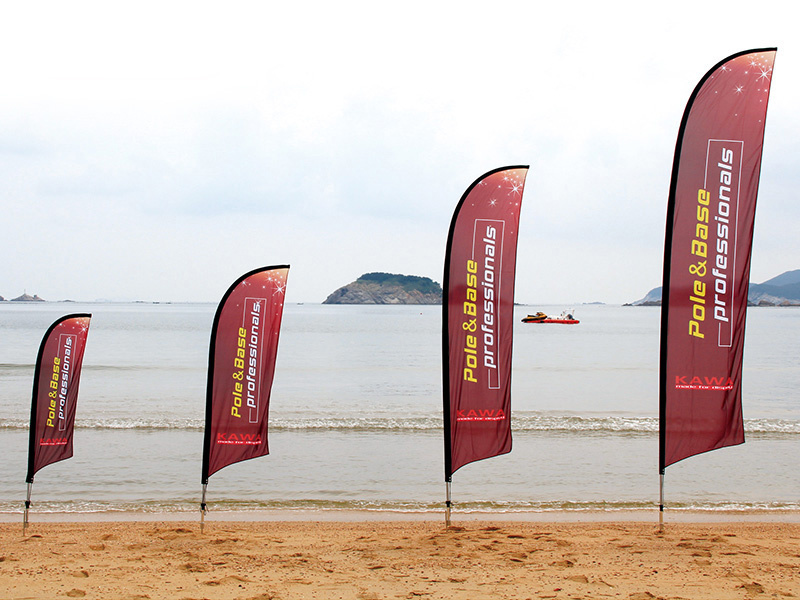
Sail flag fabric for outdoor advertising is a textile material used to manufacture curved, sail-shaped promotional flags designed for display on compatible flagpole systems. The fabric is printed with advertising graphics, cut into the required shape, and sewn with pole pockets or other attachment features.
Polyester is commonly used for sail flags because it is compatible with dye sublimation printing. This process transfers sublimation ink into polyester fibers through controlled heat, producing detailed graphics and vibrant colors.
Sail flags are often installed outside retail stores, at trade shows, sporting venues, exhibitions, festivals, and commercial premises. Their curved shape provides a recognizable advertising display, while their lightweight textile construction allows the flag to move naturally in suitable wind conditions.
The choice of fabric affects printing results, flag appearance, handling, and finished construction. Polyester is a common material for producing sail flags and other flags and banners because of its suitability for sublimation printing and its practical textile characteristics.
Dye sublimation is widely used to print full-color designs on polyester fabric. During the process, heat transfers sublimation ink into the polyester fibers rather than leaving a thick ink layer on the surface.
When the fabric, ink, transfer paper, and processing conditions are compatible, the process can produce:
The final color result depends on artwork preparation, ink quality, printer settings, transfer conditions, and the fabric itself.
Sail flags are designed to be displayed on vertical or angled flagpole systems. Lightweight polyester fabric allows the flag to move with the wind and makes it easier to fold, transport, and store.
Fabric weight should be selected according to the flag dimensions, desired drape, printing requirements, and expected display environment.
Unlike standard rectangular flags, sail flags have a curved outline. Their fabric must be suitable for cutting and sewing into the intended shape while maintaining a neat appearance around the pole and outer edges.
A suitable fabric construction helps printing businesses produce consistent flag panels and finished products.
Polyester flag fabric can be used for various promotional products, including sail flags, feather flags, custom advertising flags, and selected fabric banner applications.
The appropriate construction depends on the intended product, printing equipment, and finished display requirements.
Dye sublimation printing is a heat-transfer process commonly used to produce colorful graphics on polyester textiles. It is suitable for sail flags when the fabric composition and construction are compatible with the printing system.
The design is prepared according to the finished flag dimensions and shape. Logos, text, photographs, and promotional graphics should be arranged within the printable area.
Because sail flags have curved outlines, the artwork should account for cutting allowances, pole pockets, hems, and other sewing details.
The artwork is printed onto sublimation transfer paper using compatible sublimation inks. Printer settings and color profiles should be adjusted according to the equipment, ink system, paper, and fabric specifications.
The printed transfer paper is placed against the polyester fabric and processed using suitable heat-transfer equipment.
Under controlled temperature, pressure, and processing time, the sublimation ink transfers into the polyester fibers. Correct processing helps achieve the intended color appearance and reduce defects such as uneven color or incomplete transfer.
After printing, the fabric is cut into the required sail flag shape. The edges are hemmed or reinforced according to the finished design.
A pole pocket is normally sewn along the designated edge so the flag can be fitted to its compatible pole system. The pocket dimensions and sewing direction should be confirmed before production.
Before packaging, finished sail flags should be inspected for:
Consistent inspection helps maintain the quality of repeat orders and custom flag production.
Sail flags, feather flags, and sail banners are related advertising products, but their shapes, proportions, and display purposes may differ. Understanding these differences helps buyers select the appropriate fabric and production method.
Sail flags have a curved, sail-like outline. They are commonly used for storefront advertising, outdoor promotions, exhibitions, and events.
Their shape provides a distinctive display area for brand graphics and promotional messages. The finished size and curve depend on the flagpole system and the manufacturer's pattern.
Feather flags are another popular type of advertising flag. They generally have an elongated shape with a curved top and a relatively straight side, forming a profile similar to a feather.
They are frequently used outside shops, at trade shows, and beside roads or event entrances. Like sail flags, feather flags are commonly produced with printed polyester fabric and compatible pole systems.
Sail banners are used as fabric advertising displays with a sail-inspired profile. Depending on the supplier and product design, the term may refer to sail-shaped promotional flags or larger fabric banner products.
Buyers should confirm the finished dimensions, shape, mounting method, and pole configuration rather than relying on the product name alone.
| Feature | Sail Flags | Feather Flags | Sail Banners |
|---|---|---|---|
| General shape | Curved sail-like profile | Elongated feather-like profile | Sail-inspired banner shape |
| Main purpose | Outdoor brand promotion | Outdoor advertising and event displays | Promotional and decorative displays |
| Printing | Commonly dye sublimation | Commonly dye sublimation | Depends on fabric and application |
| Fabric | Often polyester | Often polyester | Polyester or other suitable banner textiles |
| Installation | Compatible flagpole system | Compatible feather flag pole | Depends on banner design |
| Customization | Size, print, and finishing | Size, print, and finishing | Shape, size, and mounting options |
Although these products share some fabric and printing requirements, their patterns and sewing specifications are not necessarily interchangeable. The fabric should be selected according to the final product design.
One of the main decisions when ordering custom sail flags is whether to choose single-sided or double-sided printing. The right option depends on the viewing direction, installation location, desired graphic appearance, and production budget.
Single-sided printing places the design on one side of the fabric. Depending on the fabric construction and printing method, the image may be visible through the reverse side, usually in a mirrored form.
Common characteristics include:
Single-sided flags are often selected when the flag will be positioned so that most viewers see the printed front.
Double-sided printing is designed to show graphics on both sides of the finished flag. A common construction uses two separately printed fabric panels with an opaque or light-blocking middle layer to reduce image show-through.
Depending on the design and manufacturing method, both sides can display the same artwork or different graphics.
Common characteristics include:
| Selection Factor | Single-Sided Printing | Double-Sided Printing |
|---|---|---|
| Viewing direction | Mainly one direction | Both directions |
| Reverse image | May be mirrored or visible through fabric | Designed as a separate visible side |
| Construction | Usually one printed layer | Commonly two printed layers with a middle layer |
| Weight | Generally lighter | Generally heavier |
| Production | Simpler | More involved |
| Typical use | One-direction advertising | Two-direction advertising |
Before placing an order, buyers should confirm whether the requirement is single-sided printing, a mirrored reverse image, or two independently printed sides. These are different production specifications.
Selecting suitable sail flag fabric requires attention to both printing performance and the finished product. The following factors can help manufacturers and printing businesses evaluate different fabric options.
Polyester is commonly used for dye sublimation. Buyers should confirm the actual fiber composition and ensure that the material is compatible with their sublimation ink and heat-transfer equipment.
Fabric weight affects the appearance, movement, handling, and construction of a finished sail flag.
A lighter material may offer easier handling and movement, while a different weight may be preferred for a particular flag size or sewing construction. The appropriate specification should be determined through application requirements and printing tests.
Knitted and woven polyester fabrics have different surface and handling characteristics. The selection should consider the desired appearance, cutting and sewing requirements, and printing process.
Suitable fabric width helps improve cutting efficiency and reduce unnecessary waste. Manufacturers should compare available widths with their finished flag dimensions and production layouts.
Before bulk production, test the fabric with the actual printer, sublimation ink, transfer paper, and heat-transfer settings. Check color reproduction, fine details, and consistency across the printed surface.
Sail flags require accurate cutting and sewing to maintain their intended curved shape. Pole pocket dimensions, seam allowances, edge finishing, and reinforcement should be specified before production.
Pole pockets are fabric sleeves sewn into a flag edge to accommodate a compatible pole. They help secure the printed sail flag to its display structure and maintain the intended shape during installation.
When specifying pole pockets, manufacturers should consider the following details.
Pole diameter: The finished opening should provide sufficient clearance for the intended pole.
Pocket width: The sleeve should be wide enough for installation without being excessively loose.
Pocket position: The location and length of the pocket should match the flag pattern and pole structure.
Sewing quality: Consistent stitching helps maintain the pocket during installation, removal, and normal handling.
Flag dimensions: Larger flags may require different sewing and reinforcement specifications from smaller displays.
Buyers should provide the pole specifications or a reference drawing when requesting custom sail flag production.
Sail flags are often displayed outdoors, where they may be exposed to wind, sunlight, rain, and changing temperatures. Their service life depends on the fabric, printing, sewing, installation, and actual environmental conditions.
Wind causes repeated movement and tension across the flag surface. Larger flags may experience greater wind loading, so fabric construction, flag dimensions, stitching, pole strength, and base stability should be considered together.
Flags should be lowered or removed when wind conditions exceed the limits recommended for the complete display system.
Extended exposure to sunlight can gradually affect printed colors. The rate of fading depends on the sublimation inks, fabric, printing conditions, UV exposure, and duration of outdoor use.
For long-term outdoor advertising, buyers should evaluate the complete fabric and printing system rather than assuming that all polyester fabrics provide the same outdoor performance.
Polyester sail flags are used in outdoor advertising, but moisture management still matters. After exposure to rain, flags should be allowed to dry completely before storage.
Long-term storage while damp can lead to unpleasant odors and other moisture-related problems.
Outdoor temperature changes can affect the conditions under which flags are displayed and stored. Buyers should follow the recommendations for the flagpole system and fabric care, particularly when flags are used in demanding environments.
Sail flags provide a flexible format for promotional graphics and brand identification. Their curved profile can help distinguish an advertising display from standard rectangular signage.
Common applications include:
Businesses use sail flags outside storefronts to display brand logos, product promotions, seasonal offers, and store information.
Sail flags can be positioned near exhibition stands, entrances, and promotional areas to improve brand visibility and help visitors identify participating companies.
Sports venues and outdoor competitions use printed flags to display team names, event graphics, sponsor logos, and directional messages.
Sail flags and sail banners can be used for event identification, sponsor displays, decorative graphics, and temporary promotional installations.
Restaurants, hotels, and entertainment venues can use custom sail flags to promote services, special offers, and seasonal campaigns.
Companies can produce customized flags for outdoor advertising, product launches, corporate events, and commercial premises.
For these applications, the finished product should be designed around the expected viewing distance, display location, flagpole system, and required printing method.
When sourcing sail flag fabric, providing clear technical and application details helps suppliers recommend suitable materials and reduces the risk of production mismatches.
Before requesting a quotation or fabric sample, prepare the following information:
A fabric sample can be tested using the buyer's actual printing equipment and production settings before confirming a bulk order.
HUSHENG supplies textile materials for sublimation printing and advertising applications. Choosing a fabric supplier involves more than comparing fabric names or weights. Buyers should consider printing compatibility, material consistency, available specifications, and the requirements of the finished flag.
When discussing sail flag fabric with HUSHENG, buyers can specify:
Providing these details helps identify fabric options that match the printing process and finished advertising product.
Polyester is commonly used for sail flags because it is compatible with dye sublimation printing and can be produced in different weights and constructions. The appropriate fabric depends on the flag size, printing method, and intended application.
Yes. Polyester sail flag fabric can be printed using dye sublimation when its fiber composition and construction are compatible with the sublimation ink, transfer paper, and heat-transfer equipment.
Sail flags generally have a curved, sail-like outline, while feather flags have an elongated profile resembling a feather. Both are used for outdoor advertising and can be produced using printed polyester fabric, but their patterns and pole systems may differ.
Sail banners are used for promotional displays, brand identification, events, retail advertising, and decorative applications. The exact shape and mounting system depend on the product design and supplier specifications.
Choose single-sided printing when the flag is mainly viewed from one direction and a mirrored reverse image is acceptable. Double-sided construction is more suitable when viewers need to see graphics from both directions.
Yes. Double-sided flags can be manufactured with different graphics on the front and back. The printing, fabric layers, and assembly method should be specified before production.
Sail flags are commonly used for outdoor advertising at retail stores, exhibitions, sporting events, and public venues. Their actual service life depends on the fabric, printing quality, sewing, sunlight exposure, wind, rain, and installation conditions.
There is no single fabric weight suitable for every sail flag. The selection depends on flag dimensions, fabric construction, printing requirements, desired movement, and the intended display environment. Buyers should test samples before confirming bulk production.
Most sail flags use pole pockets or another compatible attachment method to connect the fabric to the flagpole. The pocket size and position should match the pole system and finished flag pattern.
Some polyester sublimation fabrics may be suitable for both products, but compatibility depends on fabric width, weight, construction, printing requirements, and finished flag design. The pattern and sewing specifications should also be checked.
Use compatible polyester fabric, prepare high-resolution artwork, and calibrate the printer, sublimation ink, transfer paper, and heat-transfer settings. A production test helps identify color differences before bulk printing.
Allow the fabric to dry completely before folding or rolling it for storage. Keep printed flags in a clean, dry place away from excessive heat and prolonged direct sunlight.
Selecting the right sail flag fabric for outdoor advertising involves matching polyester fabric construction, dye sublimation printing requirements, flag dimensions, and finished sewing details. Buyers should also decide whether single or double sided printing is appropriate for the intended viewing direction.
Whether producing sail flags, feather flags, or sail banners, a well-planned combination of fabric, printing, pole pockets, and finishing helps manufacturers create consistent advertising displays for retail promotions, exhibitions, sporting events, and other outdoor applications.
Contact HUSHENG to discuss polyester fabric options for your custom sail flag and banner production requirements.