
Street pole banners are widely used for outdoor advertising, city streets, shopping districts, commercial developments, public events, and seasonal promotions. Their vertical format allows businesses and organizations to display messages along roads, pedestrian areas, and building entrances while making effective use of existing streetlight poles and dedicated banner hardware.
Choosing the right street pole banner fabric affects print quality, color appearance, durability, and installation. For manufacturers, sign companies, and large-format printing businesses, polyester fabric compatible with dye sublimation printing offers a practical option for producing full-color banners in custom sizes, with different finishing options for pole mounting and indoor or outdoor display.
HUSHENG supplies fabric solutions for dye sublimation applications, helping banner producers select suitable materials for different printing requirements and finished banner formats.
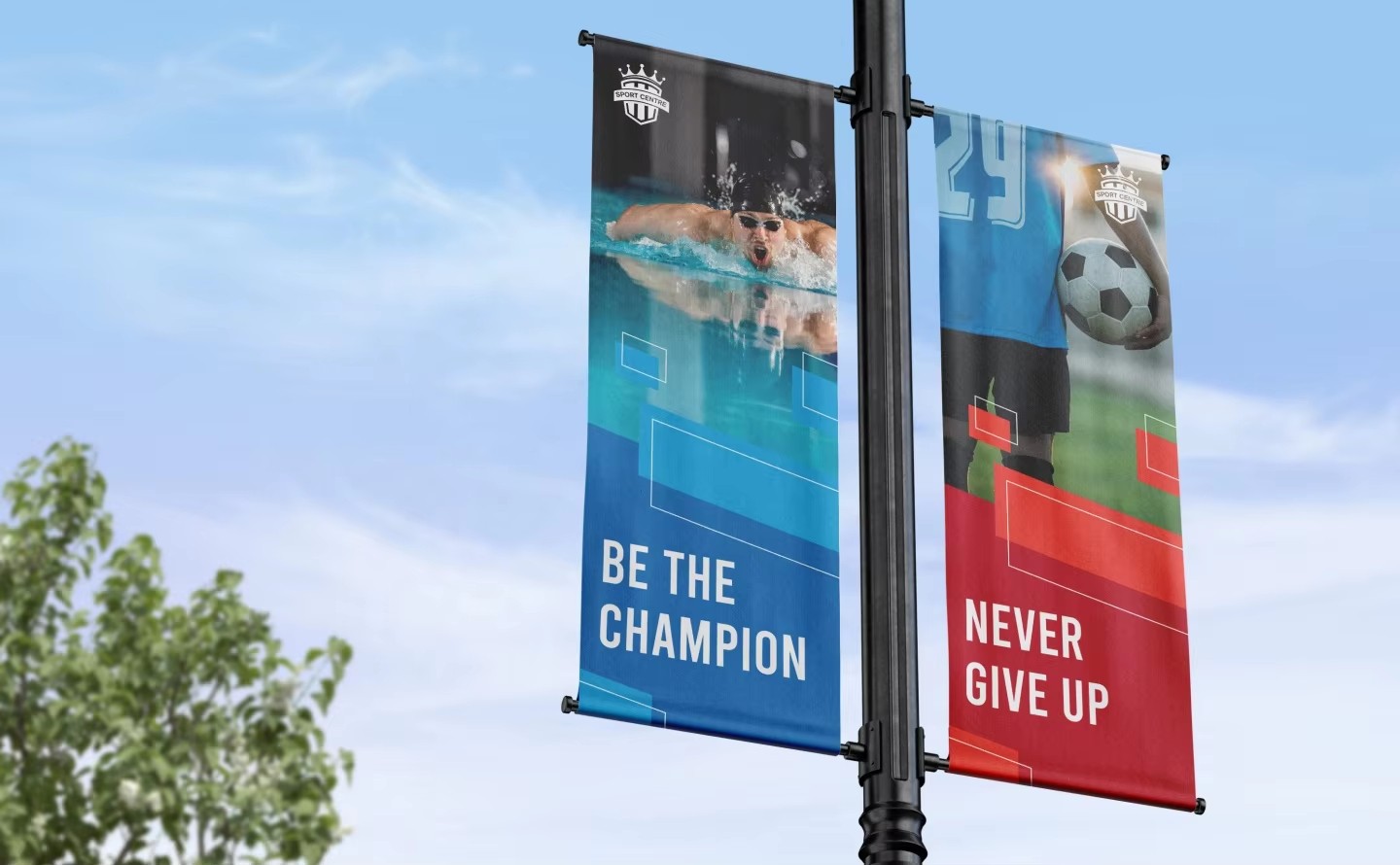
Street pole banner fabric is a textile material used to manufacture vertical banners installed on streetlight poles, lamp posts, and other outdoor structures. These banners are commonly displayed in pairs or sequences along streets, sidewalks, commercial areas, and public spaces.
For dye sublimation applications, polyester fabric is commonly selected because it can accept sublimation dyes and produce vibrant colors with detailed graphics. During the printing process, heat transfers the dye into the polyester fibers, creating a printed image integrated into the fabric rather than forming a separate surface layer.
Street pole banner fabric can be converted into different banner sizes and custom formats. Depending on the installation system, finishing options may include pole pockets, reinforced edges, and other sewing details designed to secure the banner to its mounting hardware.
Polyester is widely used for fabric banners because of its compatibility with dye sublimation printing, lightweight construction, and suitability for various display environments.
Dye sublimation is a common printing method for polyester banner material. The process uses heat to transfer sublimation ink into the fabric, producing detailed graphics and consistent color coverage.
When the fabric, ink, printer settings, and heat-transfer conditions are properly matched, the finished banners can display:
The final print quality depends on fabric construction, ink compatibility, printing resolution, color management, and production conditions.
Street pole banners are typically installed vertically and exposed to outdoor conditions. Lightweight polyester fabric can help reduce the overall weight of the finished banner while allowing it to move with airflow.
The appropriate fabric weight and construction depend on banner dimensions, installation hardware, local weather conditions, and the expected display period.
Street pole banners are produced in different banner sizes to fit specific poles, mounting brackets, and advertising requirements. A fabric supplier should be able to provide suitable widths and roll specifications for the customer's production process.
Custom sizes allow banner manufacturers to serve different projects, from small decorative street banners to larger promotional displays.
Although street pole banners are primarily associated with outdoor advertising, the same or similar polyester banner material may also be used for indoor display applications.
For outdoor banners, buyers should evaluate weather exposure, fabric strength, finishing quality, and installation conditions. For indoor display, print appearance, fabric drape, and surface consistency may receive greater attention.
Dye sublimation printing is a heat-transfer process that uses sublimation ink to create graphics on polyester fabric.
The process generally involves the following steps:
During heat transfer, sublimation ink changes into a gas and penetrates the polyester fibers. After cooling, the dye remains within the fibers, producing a printed image with a smooth surface.
This process is suitable for designs that include photographs, gradients, colorful branding, and detailed promotional graphics. Proper color management and heat-transfer settings help achieve consistent results across production batches.
Street pole banners can be produced with different printing configurations depending on the intended viewing direction and advertising requirements.
| Feature | Single-Sided Printing | Double-Sided Printing |
|---|---|---|
| Printed surfaces | One printed face | Two printed faces |
| Artwork | One main design | Same or different designs on each side |
| Construction | Usually a single printed fabric panel | May use layered fabric or a suitable blockout construction |
| Visibility | Primarily from one direction | Designed for viewing from both directions |
| Production considerations | Simpler construction | Requires additional material and finishing considerations |
| Typical applications | Wall-facing or one-direction displays | Street poles, walkways, and two-direction traffic areas |
Double sided fabric banners are designed to display graphics on both front and back surfaces. They are useful when pedestrians, drivers, or visitors approach the banner from different directions.
Depending on the required appearance, double-sided banners may use two printed fabric panels with an opaque or blockout layer between them. This construction helps reduce image show-through and allows each side to display a separate design.
When selecting fabric for double sided printing, buyers should confirm the required construction, opacity, finished thickness, sewing method, and compatibility with the printing equipment.
Finishing affects how a street pole banner is installed, tensioned, and maintained. The correct finishing options should be confirmed before production begins.
Pole pockets are sewn fabric channels that hold support poles or mounting rods. They are commonly used at the top and bottom of street pole banners.
The fabric is folded and stitched to create a sleeve through which a pole can pass. The pocket dimensions must match the diameter of the mounting hardware and the installation requirements.
For street pole banners, manufacturers commonly specify:
Many street pole banner systems use horizontal support arms at the top and bottom. In these applications, pole pockets are sewn along the top and bottom edges to hold the banner securely.
Other projects may require alternative finishing configurations depending on the mounting hardware. Buyers should provide drawings, measurements, or sample specifications when requesting custom production.
| Finishing Option | Description | Typical Purpose |
|---|---|---|
| Top and bottom pole pockets | Sewn channels along both horizontal edges | Holding mounting poles or rods |
| Reinforced edges | Additional stitching or reinforcement | Supporting areas exposed to tension |
| Double-stitched seams | Additional sewing along selected edges | Improving seam strength |
| Custom cutting | Fabric cut to specified dimensions | Matching project-specific banner sizes |
| Custom sewing | Sewing based on supplied drawings or samples | Meeting special installation requirements |
The appropriate finishing method depends on banner size, fabric weight, mounting hardware, and expected use.
Street pole banner fabric can serve a range of advertising and decorative applications. The required material and finishing depend on where the banners will be displayed.
Street pole banners are commonly used for:
Outdoor banners are exposed to sunlight, wind, rain, and temperature changes. Buyers should consider the expected display period, local climate, banner dimensions, installation method, and maintenance requirements when selecting banner material.
Similar polyester fabric may also be suitable for indoor display applications, including:
Indoor projects may prioritize print detail, color consistency, fabric appearance, and ease of installation.
Fabric performance depends on its fiber composition, construction, weight, finishing, and intended application. Buyers should evaluate these properties based on the actual conditions in which the banners will be used.
Polyester fabric generally has good dimensional stability and recovery compared with some other textile materials. However, wrinkle resistance varies according to fabric construction, thickness, finishing, packaging, and storage conditions.
To reduce creasing during transportation and storage:
Polyester fabric is commonly used for outdoor banners, but weather resistance is not determined by fiber composition alone. Fabric weight, construction, dye performance, sewing, edge reinforcement, and mounting conditions all influence how a finished banner performs outdoors.
For outdoor applications, buyers should consider:
No fabric banner should be assumed to withstand all weather conditions. For locations with strong winds or severe weather, the banner design and installation system should be reviewed carefully.
Selecting suitable banner material starts with the finished application rather than the fabric name alone. Manufacturers and printing companies should evaluate the following factors before placing an order.
Confirm that the fabric is compatible with the intended dye sublimation printing method. Direct sublimation and transfer sublimation may require different fabric characteristics and production settings.
Fabric construction influences surface appearance, drape, strength, and handling. The appropriate weight depends on banner dimensions, printing equipment, mounting requirements, and the intended display environment.
Provide the finished width and height, including any allowances needed for pole pockets, seams, and other finishing details. Confirm whether the requested dimensions refer to the finished banner or the fabric cutting dimensions.
Decide whether the project requires one printed face or double sided fabric banners. For double-sided applications, confirm whether the two sides need identical or different artwork and whether a blockout layer is required.
Specify pole pocket dimensions, top and bottom construction, reinforced edges, stitching requirements, and any special mounting details.
Indoor display projects and outdoor banners may have different performance requirements. Outdoor installations require additional consideration of weather exposure, wind load, and mounting hardware.
For banner manufacturers, printing companies, and advertising material distributors, choosing a fabric supplier involves more than comparing material specifications. The supplier should understand the complete production process, from printing compatibility to cutting, sewing, and final installation requirements.
HUSHENG provides fabric solutions for dye sublimation printing applications. When discussing a custom fabric banner order, buyers can prepare the following information to help identify a suitable material:
Providing these details helps the supplier evaluate material suitability and recommend relevant finishing options for the intended production process.
Polyester fabric is commonly used for street pole banners because it is compatible with dye sublimation printing and can produce detailed, full-color graphics. The appropriate fabric construction and weight depend on banner dimensions, printing requirements, and installation conditions.
Yes. Polyester street pole banner fabric can be used for dye sublimation printing when its construction and surface characteristics are compatible with the printing method. The printing process transfers sublimation dye into the polyester fibers using heat.
Pole pockets are sewn fabric channels that hold support poles or mounting rods. They are commonly added to the top and bottom of street pole banners to connect the banner to its mounting hardware.
Yes. Double sided fabric banners can display graphics on both sides. Depending on the required opacity and image separation, they may use two printed fabric panels with a blockout layer between them.
Single-sided banners have one printed face, while double-sided fabric banners are designed to display graphics on both front and back surfaces. Double-sided construction generally requires additional material and sewing considerations.
Common finishing options include top and bottom pole pockets, reinforced edges, double-stitched seams, custom cutting, and custom sewing. The exact configuration should match the mounting hardware and installation requirements.
Yes. Street pole banner fabric can be supplied in specifications suitable for different custom sizes. Buyers should provide the required fabric width, finished banner dimensions, and allowances for sewing and pole pockets.
Polyester is widely used for outdoor banners, but the weather resistance of a finished banner depends on fabric construction, printing, sewing, finishing, installation, and exposure conditions. Buyers should confirm performance requirements for the intended location.
Polyester generally offers good dimensional stability and wrinkle recovery, but the actual performance depends on fabric construction, weight, finishing, and storage. Proper packaging and handling help reduce creasing during transportation.
Yes. Polyester banner material suitable for dye sublimation printing can also be used for indoor display applications such as shopping malls, exhibitions, retail promotions, and event decoration.
Artwork should be prepared according to the finished banner dimensions and the printer's file requirements. Check image resolution, color settings, bleed allowances, safe areas, and the position of pole pockets before exporting the print-ready file.
Yes. An online design tool can help users create banner layouts, add text and logos, and prepare promotional graphics. Before printing, the final file should be checked against the supplier's artwork specifications, including dimensions, resolution, color settings, and finishing allowances.
Provide the intended application, printing method, fabric width and weight requirements, banner sizes, single-sided or double-sided printing preference, pole pocket dimensions, finishing options, and estimated order quantity. Artwork or installation drawings can also help clarify the requirements.
The right street pole banner fabric should match the printing process, finished banner sizes, mounting system, and display environment. Polyester fabric compatible with dye sublimation printing provides a practical option for producing full-color advertising banners with vibrant colors and customized finishing.
Whether your project requires single-sided street pole banners, double sided fabric banners, custom pole pockets, or fabric for indoor display and outdoor banners, HUSHENG can help you evaluate fabric requirements for your production needs.
Contact HUSHENG with your specifications to discuss suitable banner material, custom sizes, and finishing options for your next street pole banner project.